
FuturEcology & EmGuard ™ April 2026
In a world of chaos, let’s plant trees.
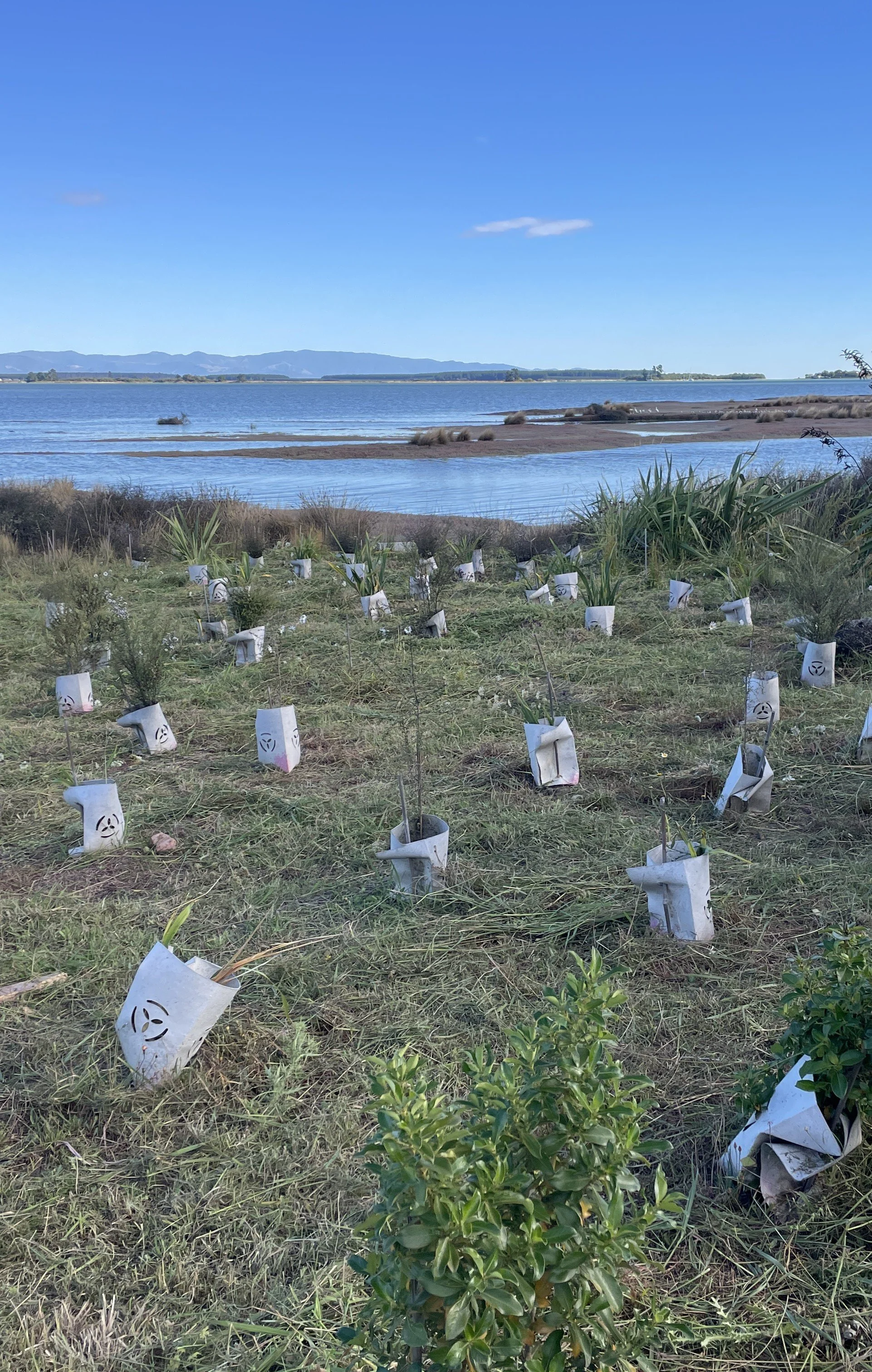
Welcome to our autumn newsletter. It’s a gorgeous day here in Nelson. One of those magic autumn days that start off quite crisp and then warm up beautifully. I even saw someone swimming at Tahuna Beach this morning.
It is becoming increasingly difficult to remain positive, as it feels like the world descends into chaos around us.
However, with good solid rain last weekend here in Nelson, it is time to start turning our heads to this season's planting.
We are thinking of our Northland and Bay of Plenty neighbours as they battled yet another major rain event. The inquest into the deaths from Cyclone Gabrielle is going on at the moment, and our hearts go out to the people who are having to relive this experience in the Coroner’s court.
I have ben reading a BBC article on "Why the world feels so unstable right now ” by Tim Palmer, which raises some interesting ideas. He talks about non-linear systems, which are systems whose outputs are not in direct proportion to inputs. Humans are non-linear systems. He points out that non-linearity is the key ingredient behind the phenomenon of chaos. He mentions the butterfly effect. This is where a small uncertainty can grow and make the whole system unpredictable.
Sometimes there can be predictability within a chaotic system for some time into the future. However, sometimes near a period of intermittent instability, the mere flap of the butterfly's wings can destroy predictability.
Weather is very much a non-linear chaotic system, as we see on a very regular basis. Forecasters now run a whole range of scenarios and simulations, particularly in relation to weather events, and try to estimate the probability, or likelihood that an extreme event may occur.
We saw this recently with the latest cyclone. The likelihood of devastation was considered high and so the nation was asked to prepare for this. Some saw it as perhaps crying wolf, but it’s far better to be prepared, than to be sitting in the Coroner's court asking why it happened.
The global economy is another non-linear system that has a profound influence on our lives. We are certainly seeing the impact of that on the world at the moment.
Do we have the power to influence this chaos?
Much of it is beyond our individual control but our response to it, starting at a personal level and moving to our community, our region, our country and the world has never been more important.
So, at a personal level, stay informed, plan for unpredictability, be prepared with a range of scenarios and work on anticipatory action plans.
Business Update
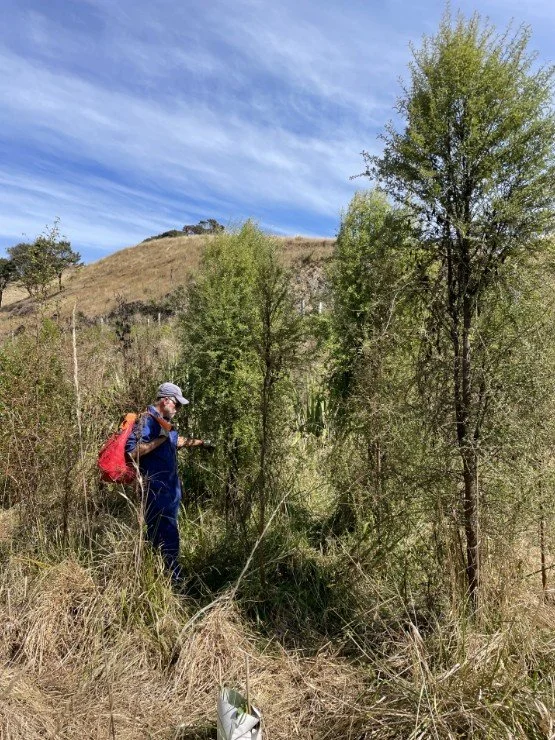
Based on the idea of ensuring in this world of chaos we are focusing on anticipatory action plans, we have been working on a range of actions.
It feels like a little more than a butterfly flapping its wings at the moment. More like a murder of crows.
In the midst of the impending fuel crisis, we were informed that the OJI factory in Hamilton (that makes our EmGuards for us) is closing down as of June 30, 2026. The continuous rise in electricity, fuel and labour cost, alongside the closure of the local pulp and paper mills and aging equipment has led the parent company to agree to close the factory. They had tried to sell it, without success.
So, what does this mean for EmGuards?
First and foremost, we are not closing down or ceasing to supply guards. The journey we took to bring these bio-degradable guards to market, and the change in industry practices around using bio-degradable guards for successful plantings, is far too important to just back away from because things have got hard.
We are currently working with OJI over the options we have and are also in negotiations with new suppliers.
Our main focus in the past was being proudly New Zealand made, from local and recycled materials.
There may be some compromises that have to be made to ensure we can still supply bio-degradable product, as the board is no longer being made in New Zealand.
Sadly, what we do know is that there will be price increases, regardless of where and how the supply is done. Fuel costs are a major driver of this.
At this stage we are unable to confirm the price rises, but we are stockpiling EmGuards for the foreseeable future and will have stock available for those who are in the action planning phase of their planting season.
EmGuard prices will remain the same for any orders placed before May 15th, 2026. Freight charges are calculated when an order is placed, and we charge freight at cost. Note that the FAF (Fuel adjustment factor) is hovering around 39% at present.
Any large orders need to be placed no later than the end of April to lock in 2025 prices.
We will advise on expected price increases as soon as we have them confirmed.
Probably, the biggest challenge of all will be whether there is actually any fuel left to move anything at all, including ourselves, around the country.
That is exceedingly difficult to crystal ball gaze for.
In the meantime, please be as organised as possible for your potential needs and let us know how we can help.
Plant of the Month
Black Maire - Nestegis cunninghamii
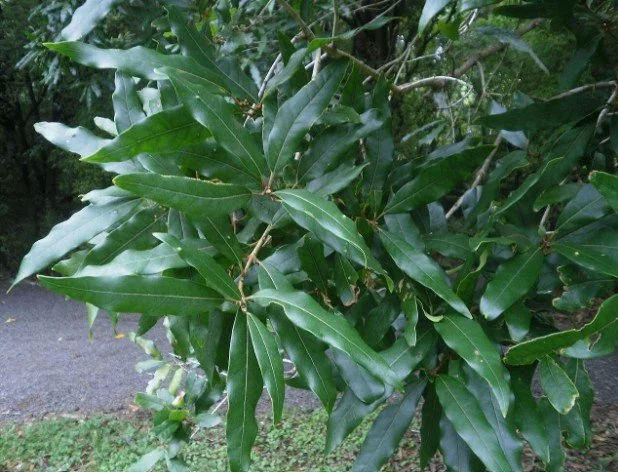
This is an evergreen tree, growing to over 20m in height with a trunk diameter of up to 1.5m.
It is found throughout the North Island and northern South Island in lowland and montane forests and is often associated with damp gullies.
It has some unique features, an important ecological role and is culturally significant. It is identified often by its rough, corky bark with a tessellated (square-patterned) appearance.
It has long, narrow, dark green leaves, arranged in opposite pairs. The leaves are between 7-15cm long and 1.5-4.5cm wide, with a leathery feel. They have a pronounced sunken midrib on the upper surface and clearly visible veins on the pale green underside.
Flowers are produced in spring. These are small, 3-5 mm in diameter with 4 green petals. They develop into striking red or yellow fruits (drupes), which contain a single seed.
Black Maire prefer partial to full shade and have moderate to high water needs. Frost tolerance is moderate and salt tolerance is low.
It holds significant cultural importance. The dense and durable timber was highly prized for tool and weapon construction. It was used for digging sticks, spades, canoe paddles and bailers, mallets, double pointed spears and construction of houses. Europeans settlers used it for wheels or shaft bearings, framing for railway carriages, fences and bridge building. Sadly, it was also found to be extremely good firewood, which is probably why it is relatively scarce.
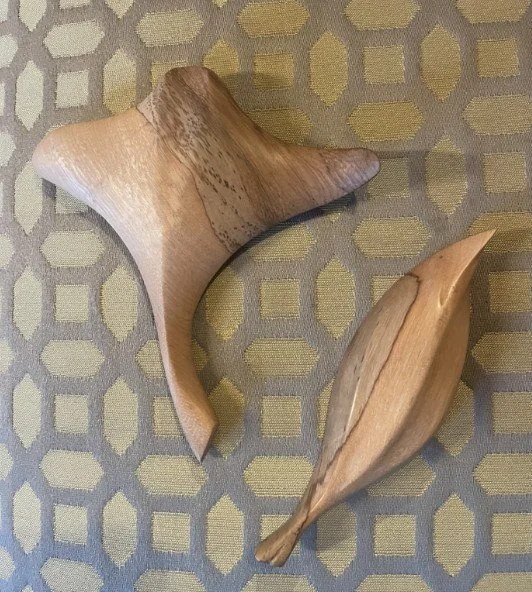
Robert has found the wood to be extremely beautiful, if somewhat hard to carve. It takes an amazing finish.
Weed of the Month
Black nightshade (Solanum nigram)
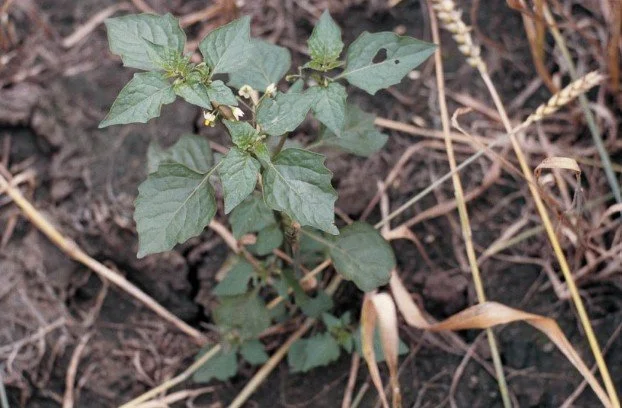
We have been out doing more weed control work in some of our older plantings and finding quite mature, fruiting black nightshade. The distinctive black berries, 7-10mm are found on mature plants.
It is not to be confused with deadly nightshade (Atropa bella-donna).
It is found throughout New Zealand, particularly on disturbed ground. In the seedling state, the leaves are oval to egg-shaped and sparsely haired. The leaves are alternate on the stem with veins radiating outwards.
Once mature, the plant produces strong, multiple stemmed and spreading plants up to 750mm tall. The leaves are dark green, coarsely toothed and pointed at the tips. Flowers are white to pale mauve with 5 petals and a yellow centre. Berries are a distinctive green that ripen to shiny black. These are not highly toxic, but could cause issues if consumed in large quantities.
Control by hand weeding seedlings. They become harder to pull out once mature.
It can also be controlled by cultivation and most common herbicides.
Projects Update
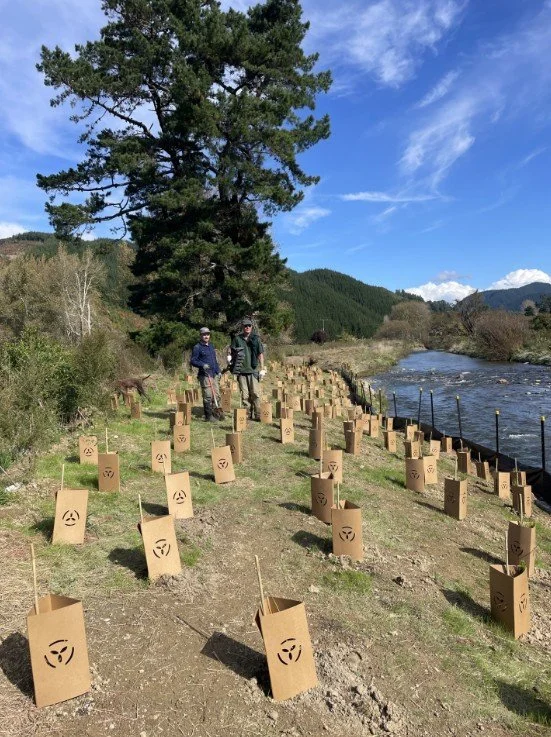
First planting of the season.
We started on a battered bank by the Wakapuka River. The idea with this area was to reduce the undercutting of the exisiting bank. This undercutting was occuring during flood events. The plan is that by softening the batter of the bank and planting densely with Carex secta and Phormium tenax, we will reduce erosion.
EmGuard Update
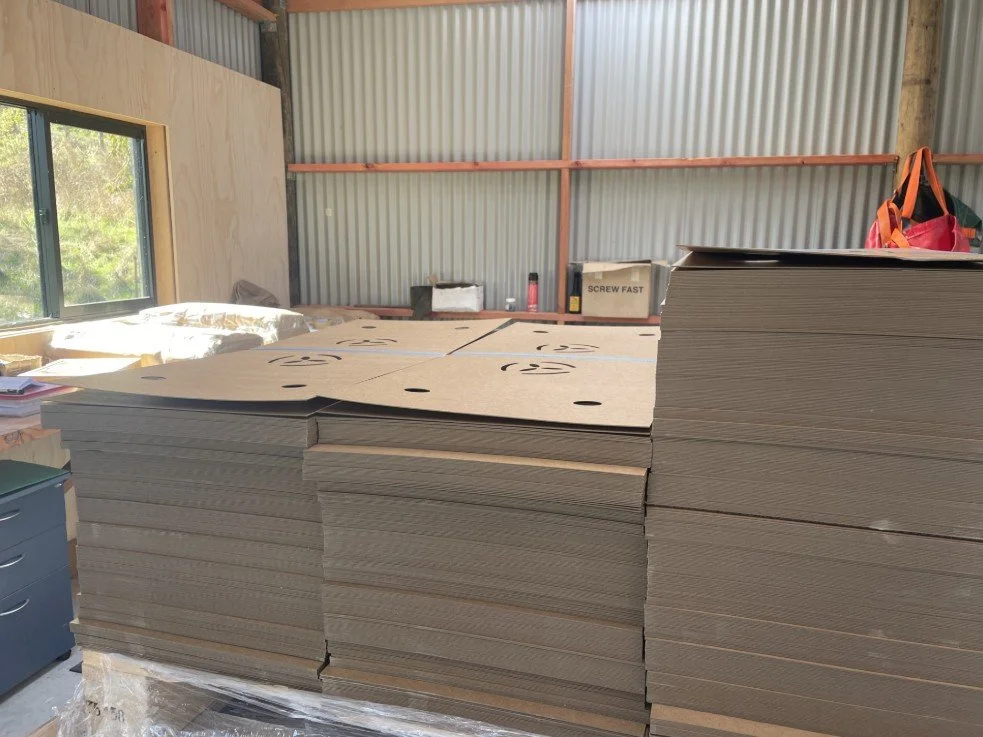
I have stock on hand at 2025 prices. Get your order in before the first of May to beat the price rise.
Jan’s details are:
Ph: 027 497 5838
Interesting Snippets
What we’ve been watching

Riot Women.
If you enjoy quality British drama with excellent casting, wonderful actors and a gritty script, then this is well worth watching.
Written by Sally Wainwright of Happy Valley fame, it follows 5 ordinary women of a certain age, who come together in Hebden Bridge, Yorkshire, to create a makeshift punk-rock band to enter a local talent contest.
They plan to do a cover song from Abba for the talent quest, but in the process, discover that they are all somewhat angry about how society treats women in general, particularly as they get older. They end up writing their own songs, as they find they have a lot to say. They juggle demanding jobs, ageing parents, menopause, grown up children, absent partners, relationship issues and all things life can throw at them.
As they develop into a band, they discover the opportunity the band brings as a catalyst for change.
The acting is superb, the music is great and the story is very relatable in places.
What we’ve been cooking
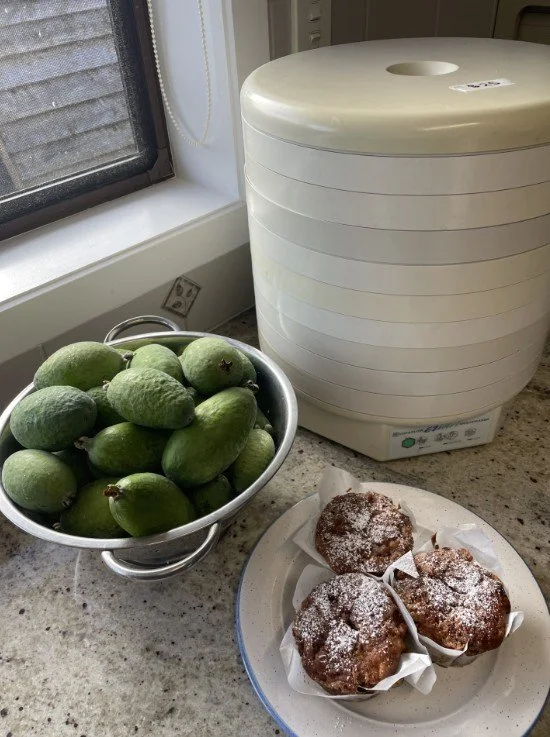
Feijoas, feijoas, everywhere!
With such an abundance of these New Zealand favourites, we are busy stewing, dehydrating and baking with this fragrant fruit. Here is the Feijoa Muffin recipe we used for our morning tea today. A couple of tips - use Texas muffin pans and line with squares of baking paper. This is cheaper than muffin cases, and looks more generous!
Ingredients
1 cup feijoa pulp (about 6–8 feijoas, scooped)
1 ½ cups plain flour
¾ cup sugar
1 ½ tsp baking powder
½ tsp baking soda
½ tsp salt
1 tsp cinnamon
2 eggs
⅓ cup rice bran oil (or melted butter)
¼ cup milk
1 tsp vanilla extract
Method
Preheat oven to 200°C (this helps get that nice high muffin top). Grease or line a 6-hole Texas muffin tin.
In a bowl, mix flour, sugar, baking powder, baking soda, salt, cinnamon
In another bowl, whisk eggs, oil, milk/yoghurt, vanilla
Stir in the feijoa pulp
Combine wet + dry gently (Don’t overmix)
Divide evenly into 6 large muffin holes - Fill them generously (almost to the top)
Bake:
200°C for 5 minutes. Then reduce to 180°C for 15–20 minutes. Done when golden and springy on top.

Conclusion
Anzac day is on the horizon. A time to reflect on what really matters and the absolute futility of conflict.
The recent trip into space by the Artemis II astronauts, where they saw sights that no human has ever seen, was pretty incredible.
However, what they did note was it has shown “how fragile we are in space”
They hope to use the mission as the launchpad to protect the planet more.
Each of us can do our own little bit. Less unnecessary trips in the car, more trees in the ground and appreciating the good things we have.
Give your family an extra hug this Anzac Day.
If you have any projects in mind and would like to talk further, give us a call or pop in and see us.
We look forward to hearing from you!