
FuturEcology & EmGuard ™ March 2026
An interesting year so far.
The one thing we know for certain at the moment, is that we are enjoying this autumn weather. Day after day of sunshine, but cooler overnight temperatures have made for good days to catch up on field work. Mind you, we definitely need some rain.
In this world of uncertainty, the one thing we can control is our attitude to each day, so we are trying hard to do that.
Much of what we are experiencing in business at present is totally beyond our control. From my days of studying management, we would always talk about PESTEL. This is a strategic management tool used to analyse external factors - political, economic, social, technological, environmental and legal that can impact on an organisation’s operations and strategy.
The other day, I heard an economist say on the radio that we were experiencing rising prices and that would affect people! Who would have thought? I don’t think we need economists to tell us that!
Luckily, last year, we at FuturEcology did some naval gazing to focus on strategy for the next few years. Mind you, we did not factor in a war in the Middle East and the escalating costs of fuel, or the increasing cost of electricity in New Zealand. These are all impacting manufacturing, and we are seeing factory and business closures every single week.
However, in our business, the weeds continue to grow and we are pleased to see people still focused on improving the environment through planting projects. Keep up the great work.
We do, however, need to signal some upcoming changes to our prices and supply. Fuel has gone up incredibly in the last two weeks, which has affected the cost of freighting, and we can no longer absorb this cost.
We only charge freight at cost to our customers. Freight costs are changing on a weekly basis. The Fuel Adjustment Factor (FAF) is now reviewed on a weekly basis and has increased to a rate of 24.4% as of the 17th March. This will be applied to all our freight costs going forward and may be adjusted on a weekly basis, as we are advised of changes.
We will quote freight costs to the best of our knowledge with all orders received.
There are other changes in the wind with our manufacturer of EmGuards and we are working closely with them to navigate this process. We have always been very focused on EmGuards being proudly New Zealand made.
In the meantime, it will be prudent to get your orders confirmed as early as possible, so we can get them underway. The middle of May will be the cut-off for any large orders. We are committed to holding our current prices for EmGuards until the 30th May 2026. $1.55 exc GST each for orders over 3000 and $1.75 exc GST each for orders under 3000.
We will continue to hold stock for smaller orders after May 30 2026, but unfortunately, there will be a price increase. Supply for late season plantings may be limited, so please plan ahead.
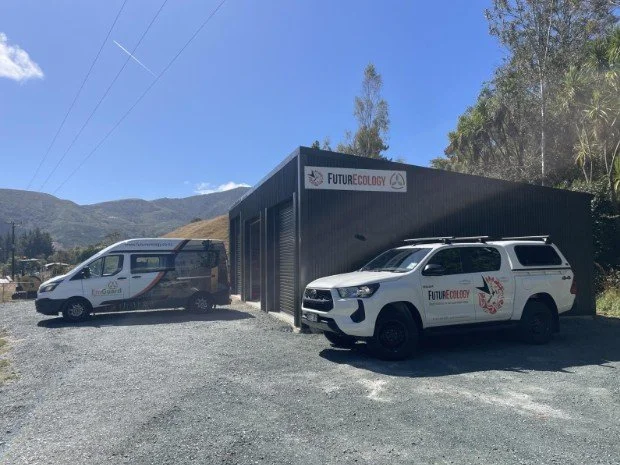
Our new shed at 84 Ross Road, Hira is up and running and we are slowly but surely finding the right home for everything. It’s a great spot to work from and we welcome visitors.
If you wish to call in, however, please give us a call first, to make sure someone is around - 027 497 5838. We may well be out in the field giving all our plantings the best chance of success.
Place to Visit - Onamalutu Reserve
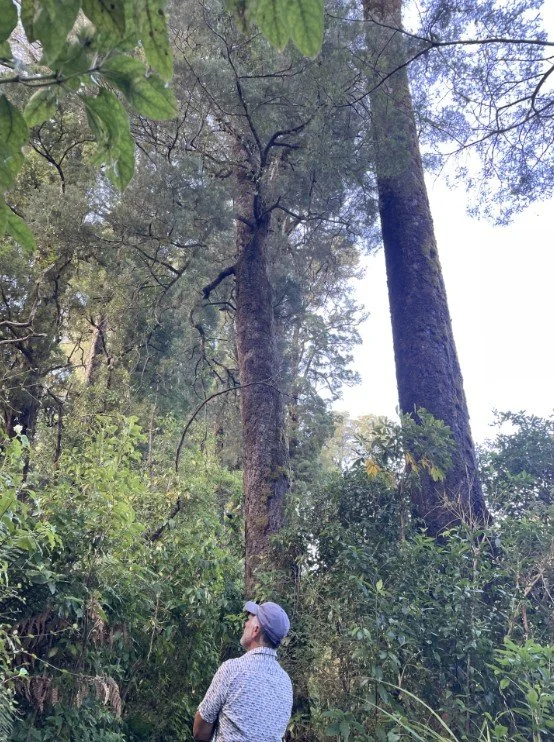
We recently delivered EmGuards to a project being done in the Onamalutu Reserve on the North Bank of the Wairau River in Marlborough.
This is a site of impressive remnant podocarp forest and is administered by the Department of Conservation. There is a campsite there with basic facilities, that can be booked through DOC.
The site was gifted to the community in 1901 by a local sawmiller. It is amazing that these magnificent trees were saved and are so easy to access. What I enjoy about sites like this, is seeing the layers of plants within the bush. The tall canopy trees, the mid-height trees and the low ground covers and ferns.
It is well worth a detour off the main road if you have the time.
Plant of the Month
Melicytus lanceolatus, Māhoe-wao or narrow-leaved mahoe
We observed this distinctive tree, with it’s lovely shiny leaves, in the Onamalutu Reserve. It is a small, bushy tree, that prefers high rainfall areas. It has downward curving, tough, shiny narrow leaves on a short stem, 5-16cm long and 0.5-2cm wide. The leaves may be slightly serrated along the margin. They can resemble willow leaves. Flowers are small and fragrant, with yellow or dark purple petals and are scattered in groups along the twig.
Small, dark purple berries follow, that are good food for birds.
It is commonly found in lowland and montane forests. It prefers moist, well drained, fertile soils, and consistent rainfall. It needs to be protected from wind and frost during establishment.
It can be grown from seed or semi-hardwood cuttings and is a valuable addition to a native planting, providing both ecological and aesthetic appeal.
Weed of the Month
Mahonia japonica, Architectural holly
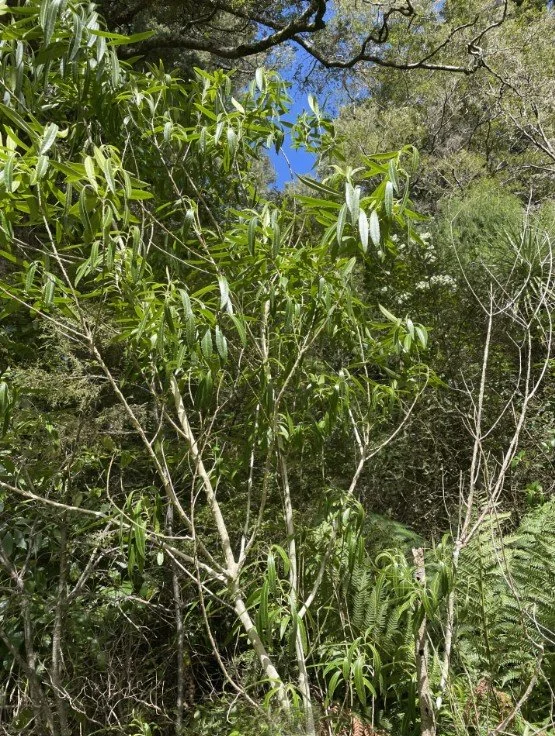
We have recently gone back to working in a remnant lowland coastal forest that has some magnificent old trees. Unfortunately it has been infested with a garden plant, mahonia, which has the capacity to totally dominate the forest understory, if left unchecked.
We have been working in this forest since 2018, slowly but surely trying to get on top of this weed.
It is related to barberry and is more than happy to thrive in shade and poor soils.
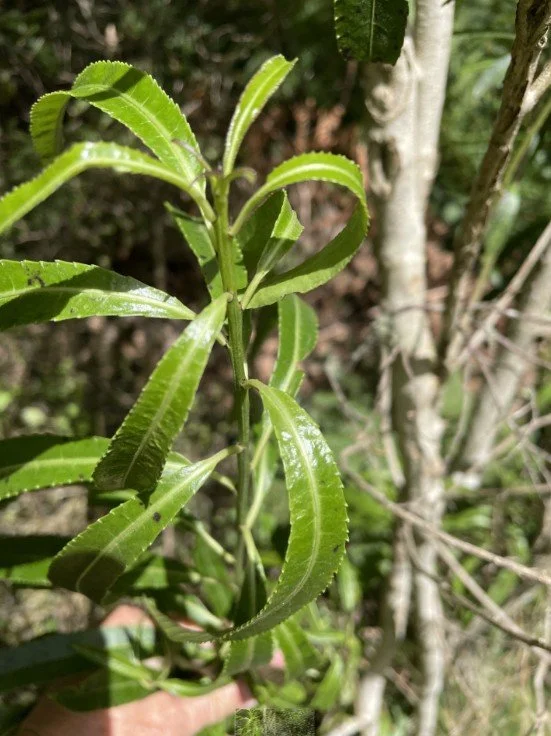
It has distinctive leathery, spikey foliage, green on top and silvery underneath, bright yellow flowers in mid-winter, followed by bright yellow berries borne on bracts. The stems are quite wrinkly and bright yellow inside when cut.
In its seedling phase, it looks very like a juvenile kawakawa, so searching for it in a kawakawa filled forest is very difficult.
What we have observed is that it particularly likes to grow under thick blackberry. I’m sure this relates to the fact that birds eat the mahonia berries and then go and eat blackberries and leave the seeds behind. It has meant that we have had to first remove thick stands of blackberry to get to the mahonia seedlings.
They have a deep taproot, so control has been based on pulling out very small seedlings where we can, or cutting and pasting with Glimax professional “Cut N Paste”.
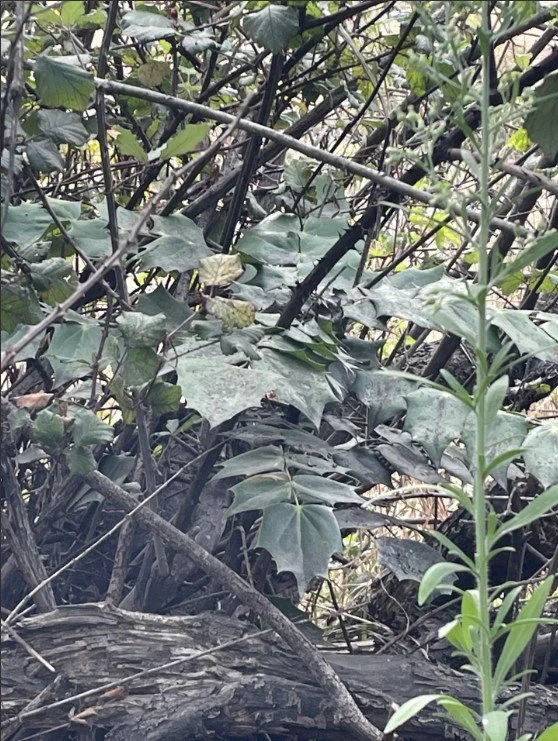
Mature mahonia
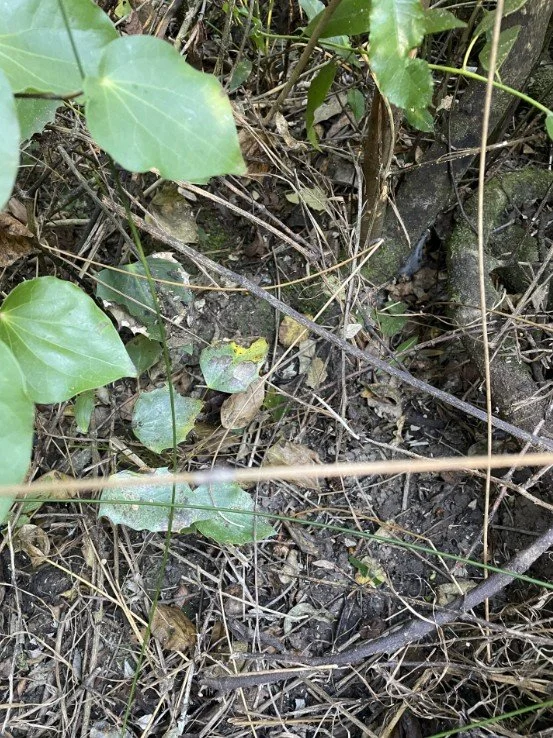
Mahonia seedlings beside a kawakawa
Sheep Trial Update
Vine weeds like convolvulus and old man’s beard are the bane of our lives in plantings. We have been trialing using sheep, to try and assist with controlling these weeds.
They are so far proving to be quite a valuable tool in our war on weeds, providing we manage the process quite strictly.
We have been putting them into the three year old plantings, with temporary fencing. We have just used lambs, not older sheep. It is crucial to make sure they are only in there for a limited time, so they don’t get hungry and start looking hungrily at our precious plants.
So far, they have proved particularly good on convolvulus, as that is one of the first weeds they target.
We will continue to monitor this trial and keep you updated.
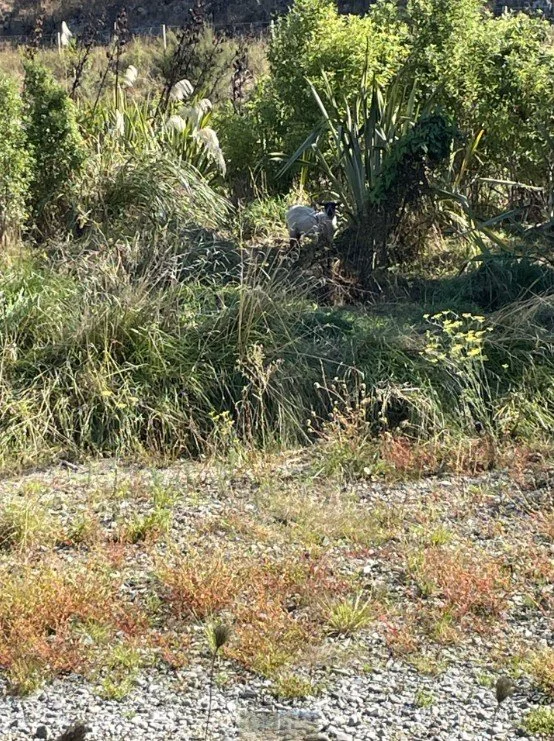
One of the sheep enjoying its varied diet
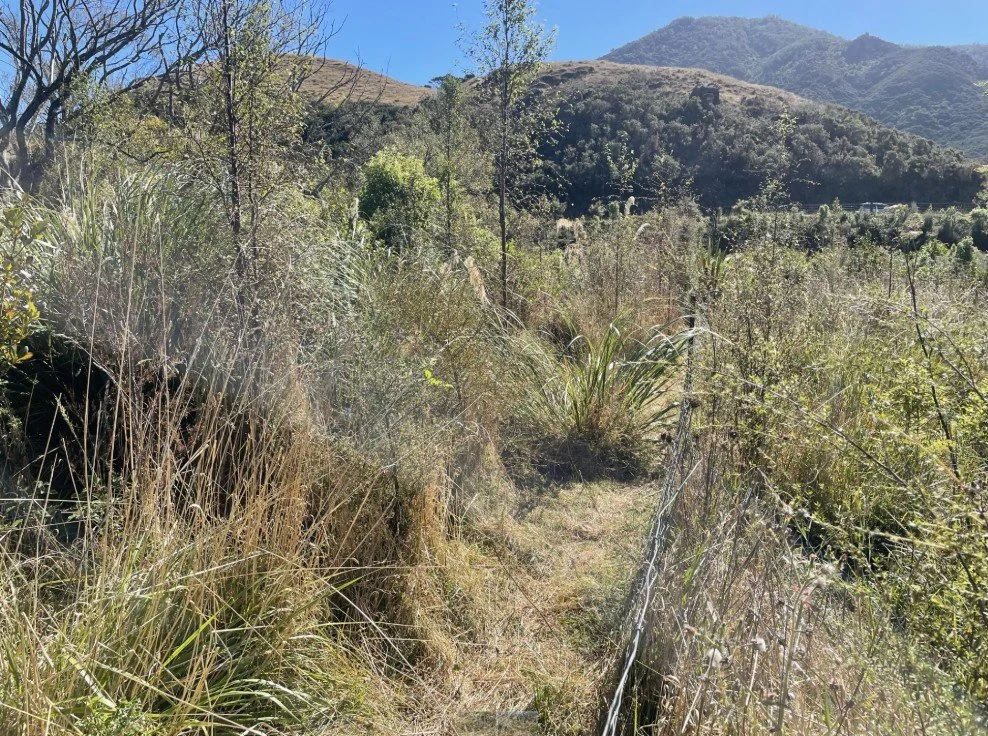
Evidence of the sheep controlling weeds along the fence line
EmGuard Update
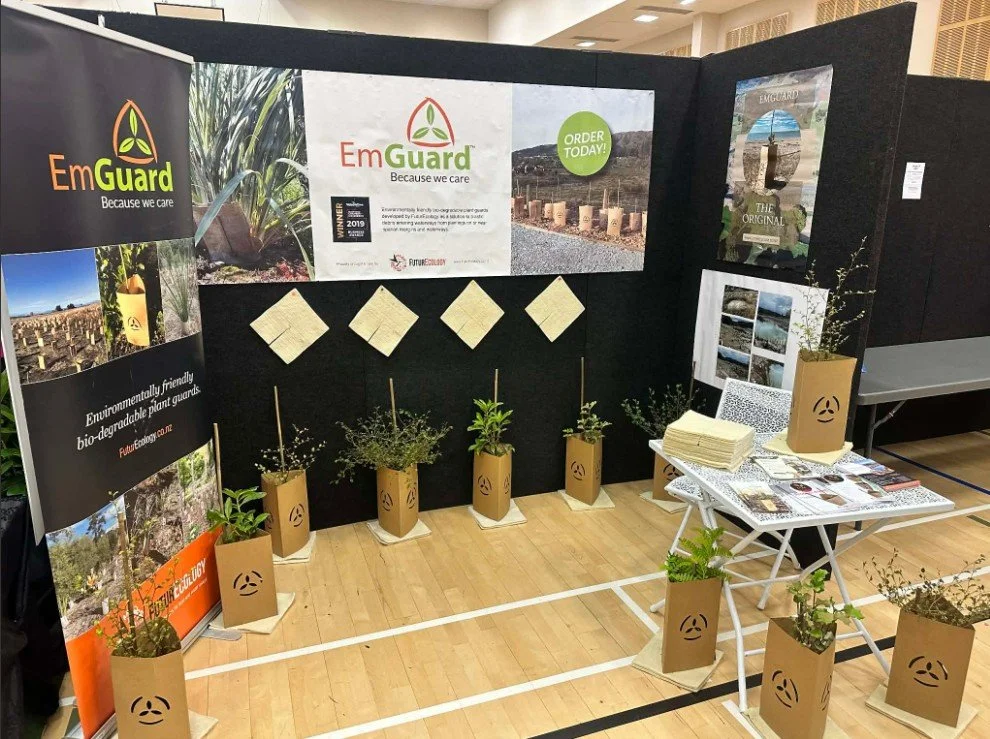
We have good supplies of EmGuards available at present, but upcoming fuel shortages and supply issues will impact on our ability to guarantee timely supply.
If you know your needs, please let us know as soon as possible.
You don’t necessarily need to buy them right now, but if you can possibly give us an indication of your plans, that will certainly assist us in managing our supply.
Jan’s details are:
Ph: 027 497 5838
Interesting Snippets
What we’ve been reading
Revenge of the Tipping Point – Malcolm Gladwell.

This follows on from his best-selling book, The Tipping Point.
It revisits some of the concepts he explored in the first book, but he shifts his focus to the negative and unintended consequences of tipping points in society.
He uses a series of case studies to examine how individual actions, environmental factors and systemic conditions can create ripple effects across society.
One that I found particularly fascinating was his concept of the “magic third” which explores how having a critical mass of minority representation – in the workplace, boards or politics can shift social dynamics.
He also explores the role of the media in societal tipping points.
His writing style is very readable and the stories he relates are fascinating. A very timely read, given the state of the world at present.
Conclusion
We live in challenging times.
As I write this newsletter, I have reflected on what FuturEcology has achieved over our nearly 12 years in business. We are exceedingly proud of the difference we have made to our environment and also to the people whose lives we have touched.
We hope to continue making a difference, but crystal ball gazing at the moment is more than difficult. Outside factors are having a huge impact on every business at present, and we are all having to navigate daily challenges.
Please follow us on our FaceBook page for regular updates on what we are doing and keep up the great work you all do on making our precious planet a safe place to live.
We hope you all take the opportunity to have a good break over the Easter holiday.

If you have any projects in mind and would like to talk further, give us a call or pop in and see us.
We look forward to hearing from you!