
FuturEcology & EmGuard ™ May 2026
Keep on keeping on.
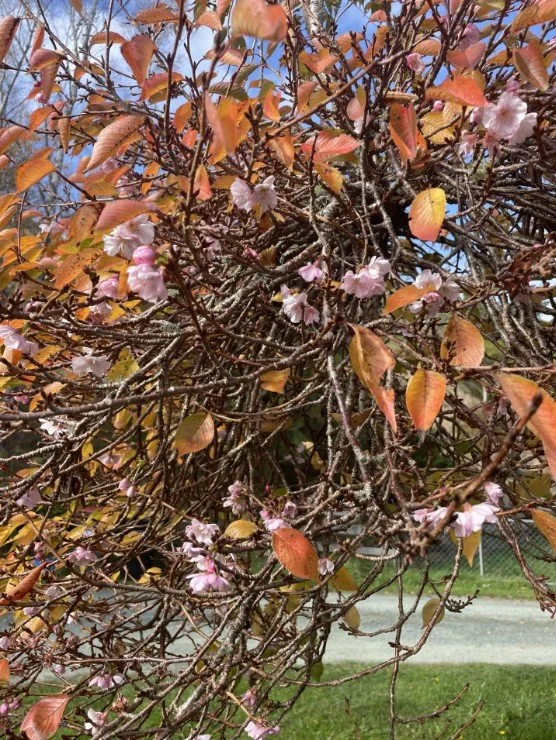
One confused cherry tree - blossoms and autumn leaves at the same time?
Welcome to our May newsletter.
Not a lot has changed since our last newsletter as we continue to watch the state of the fuel crisis, weather events and the ongoing challenges to business and the people of New Zealand.
I read some really interesting statistics the other day relating to weather events and the number of insurance claims in the last year.
Between March 2025 and the end of February 2026 there have been 46 storms. Associated with that were more than 33,000 insurance claims. The previous year there had been 19 storms and approximately 9,000 associated claims. An increasing number of these events are now happening in spring and summer, reflecting changing weather patterns.
The insurers are saying that an increasing number of New Zealanders were aware of the risks of climate change related events and were taking steps to protect their properties. However, they reiterated the need for more investment in resilience.
75% of New Zealanders want to see more investment in managing risk. However, there is a current mismatch between the level of concern and the national response to the problem.
The issue is that we tend to respond after an event, rather than focusing on managing risk up front.
I certainly see the importance of the role we play, along with all our clients and colleagues, in investing in resilience.
Last month, we started on our annual planting projects, including planting a riverbank that we are experimenting with by battering and planting in Carex secta and Phormium tenax. The hope is that by reducing the angle of the riverbank and protecting it with species that will form a solid root mass, while also folding down in a flood situation, we can reduce the erosion happening along the river edge. The other option is rock armouring, but this has other consequences, including lack of shading and raised water temperatures.
We also planted a new wetland that is being created following gravel extraction. This particular site was severely damaged in the Motueka flooding in 2025, but has bounced back amazingly well.
The climate spokesperson for IAG insurance, Bryce Davies, said that the country is experiencing more severe storms, more often. The current approach to the level of concern and the national response is mismatched. He says that at the moment, the response feels very ad hoc and fragmented. It doesn't feel like there is a coherent system. What he would like to see is a systematic response, focused on the real hotspots and enabling councils to do what they need to do. This includes ensuring planning laws, funding and guidance is there.
The Insurance Council chief executive, Kris Faafoi, said there needs to be greater urgency from the government on how climate adaptation will be funded.
The key message was that having a co-ordinated response to climate related hazards “makes our job a hell of a lot easier”.
This is true for us too.
We have seen a very ad hoc response to environmental projects around the country. Many of these projects have aspects of climate resilience built into them, as well as biodiversity outcomes.
We are currently working with local MPI staff, contractors and members of the community, looking into what a co-ordinated approach to climate adaptation, particularly around revegetation and restoration, might look like. This would include things such as industry standards, training, a potential professional body, and consistency in environmental standards for revegetation/restoration initiatives. This is in its very early stages at present, but something we see as vitally important for the future of sound and cost effective environmental and climate adaptation projects.
Watch this space and please send in any ideas you might have or needs you have identified.
Planting tips
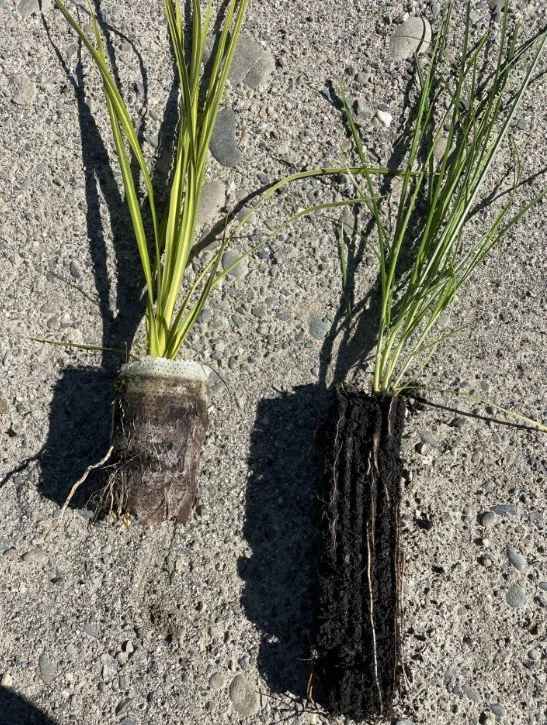
The example on the right shows an under developed root system. The plant on the left is grown in an ellepot, showing good root development.
As we begin this season's planting, one of the most important things for us is the health of the plants we are planting, and particularly the state of the rootball. The integrity of the rootball will largely determine how well the plant will establish in its new environment.
In early plantings, one of the problems we have encountered is a very loose rootball, with the dirt falling off the roots as they are removed from their growing containers.
The root system of any plant is its lifeline. It absorbs water, nutrients and anchors the plant in place. Disturbing the roots can cause stress or damage, leading to transplant shock. This can be characterised by wilting, yellowing leaves, slowed growth or death.
Container grown plants generally have confined rootballs already formed. You should be able to slide them out cleanly and easily from the container with as little breaking apart of the soil on the rootball as possible.
If you are unsure of the state of the rootball, check this before taking your plants to the site. It is far easier not to take the plant from the nursery in the first instance. Otherwise, you can get all the way out to your site and find that the rootball is very flimsy or the plants are so embedded in their pots that they won't come out without severely damaging the plant.
An intact rootball anchors the plant firmly when it is put into its new location. This allows it to quickly adapt to sending out new feeder roots to ensure effective uptake of water and nutrients.
Our advice is that if you are unsure of the root development on plants you are purchasing, check them out in the nursery by sliding them carefully out of their container before you take them away. Leave behind any plants that don't have a strong, sound rootball.
We have been advocating for collecting our plants already removed from their containers and placed in cardboard boxes for transporting to site. This means that there is a better chance of ensuring they have sound rootballs and it becomes the responsibility of the nursery to provide well established plants. It also reduces plastic in the field and makes transporting large numbers of plants a great deal easier.
Plant of the Month
Black Beech or Tawhairauriki, Fuscospora solandri
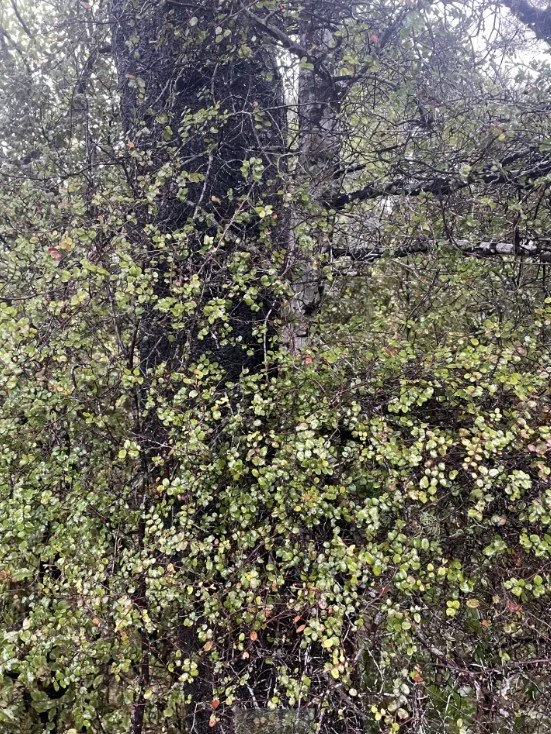
A large, evergreen tree, endemic to New Zealand. It is often a dominant canopy tree, growing up to 30m tall in lowland to montane forests. The bark is rough and furrowed and typically charcoal black. It often appears as sooty due to the presence of scale insects, which excrete honeydew, an important food source for our native birds.
Leaves are small and leathery, dark green and oval shaped measuring between 10-15mm. The leaves are pale underneath with a slightly incurved margin and rounded tip. The leaves deepen in colour during the winter.
Flowers are small, red/brown coloured and inconspicuous. They are produced in spring and are important as a food source for native birds.
Black beech thrives in full sun, or partial shade on well drained sites. It is frost tolerant and can be found in cooler climates.
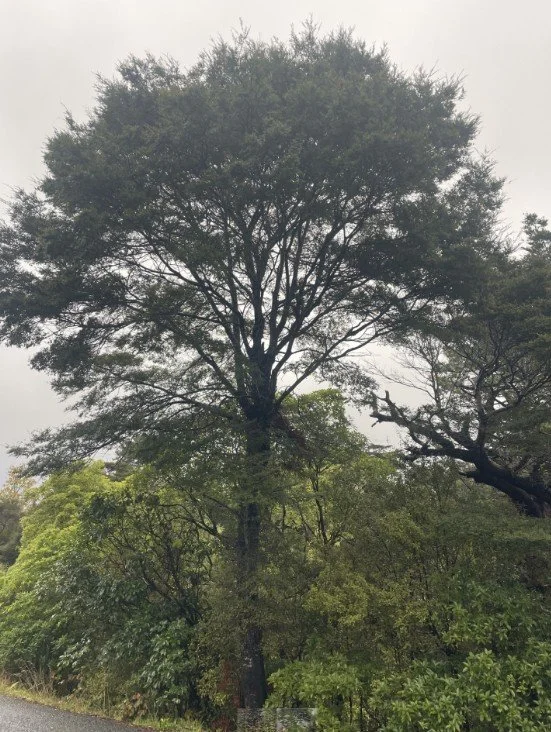
Its growth rate is relatively fast and will regenerate reasonably prolifically in natural forest. It establishes well from seed, but is susceptible to drought and hard frosts in the early stages. It establishes best if planted in partial shade or shelter from other plants.
It is vulnerable to browsing by deer and goats.
They have reasonably shallow root plates, so can be prone to wind throw as they age.
Interestingly, black beech is being planted as a timber species, due to its relatively quick growth and its durability as a medium density hardwood with a fine, straight grained, even textured wood. The heartwood is building code compliant for durability in internal structural applications, flooring, exterior weather boards and decking. It can be harvested if it has been planted specifically as a timber product, but the owner must have obtained a certificate from MPI.
The harvested logs can be quickly attacked by pinhole beetles, so they need to be milled soon after felling.
If land is registered under the Emissions Trading Scheme and beech trees are planted to comply, ie at least 1 hectare and more than 30% crown cover per hectare then they may be eligible to earn carbon credits.
Weed of the Month
Parramatta Grass, Ratstail grass, Sporobolus africanus
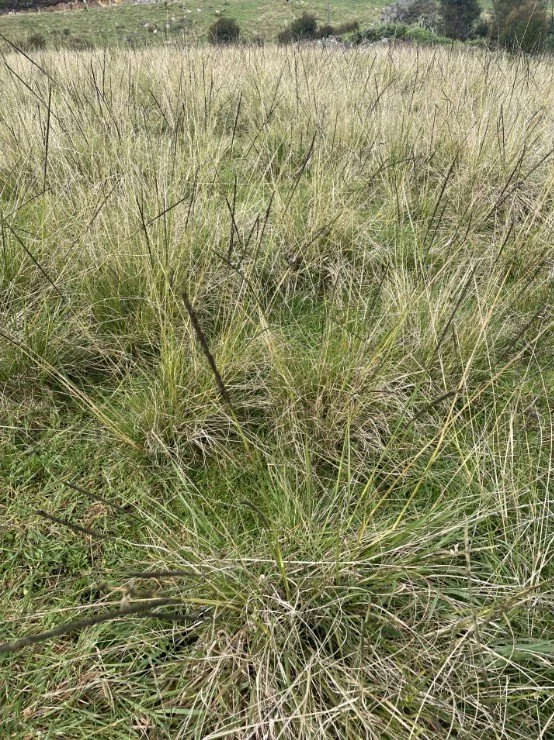
We were recently at a coastal site that is lightly grazed and edged by native regenerating bush. The grazed area had an interesting looking grass that was clearly not palatable to sheep. Ratstail grass is a very appropriate name, as the seed heads have a definite rat’s tail appearance.
It is a stiff, tufted perennial grass, 20-80cm high with flat leaves up to 5mm wide or in–rolled leaves 0.2 - 2mm in diameter. It also has a taller, narrower, olive-green spike-like panicle. Leaves grow between 10-25 cm long and are hairless on the upper surface, but rough on the ribs and margins on the lower surface. The leaves and stem are tough and very difficult to break.
The flower head is 9-22cm long and 4-8mm wide. It is more or less continuous, but with some separate branches at the base. The spikelets are 2-3 mm long and black-green in colour. The yellow brown seed falls free from the glumes at maturity.
It originates from East Africa and was first recorded in NZ earlier than 1840.
It is very drought-tolerant and a prolific seeder (up to 3600 seeds per square metre per year). Plants will survive light frosts and are often seen on dry, sunny faces.
It is partially resistant to mowing and can grow through asphalt on road edges. It is a poor stock food and is resistant to treading and grazing.
Control.
If infestation is small, then manual removal is recommended. Bag and remove from site or burn.
Limit seed set by topping, if infestation is large.
Glyphosate will control it, but re-treating will be required.
Once controlled, keep site covered in quality pasture or plants to shade it out.
(AgPest)
EmGuard Update

EmGuards are going out at a great rate. Keeping up the supply to meet the demand is my ongoing challenge, so if you know your future needs, please let me know as soon as possible.
It is lovely to hear from our customers from all over the country, saying how good they have found the guards. I had a wonderful endorsement from a customer in the Waikato the other day. I still remember her arriving at our stand at Mystery Creek a couple of years ago in the pouring rain. She looked at our guards and said “that is just what I need. I just planted 1000 plants and the hares have destroyed nearly every one of them”.
Two years on and she is thrilled with how they have helped in the establishment of their new forest.
As we said in the last newsletter, the factory that makes our guards is closing down at the end of June. We are having very positive discussions with potential new suppliers of the board, so will keep you informed of progress.
I am not sure how long the transition phase will take, so in the meantime, please let us know what your present and future needs may be, so we can do some accurate forecasting and planning.
I am holding our current price in the meantime: $1.75 exc GST each for guards, 32 cents exc GST for canes and 80 cents exc GST for dagwool mats.
Freight is charged at cost.
For quantities over 1500, please contact us to discuss wholesale rates.
Jan’s details are:
Ph: 027 497 5838
Interesting Snippets
What we’ve been reading

Robert has had a bit of a binge on New Zealand fiction writers lately and has really enjoyed their books.
Derek Hansen – Remember Me.
Auckland 1956, a 12-year-old boy writes an essay and inadvertently uncovers a wartime secret that unleashes a chain of events which rips a close community apart.
The war may be over, but the boy discovers it is far from done with.
It is a poignant and gripping tale of events, which challenge and define a post-war community.
Set in Auckland, there are many familiar places and scenes we can relate to.
Geoff Parkes – The First Law of the Bush.
Bill Dickerson thinks it’s a beautiful day to be alive, seconds before he tumbles from a viaduct onto jagged rocks below.
His widow is seeking answers and hires a lawyer, who has recently returned to the small town of Nashville, to fight for her.
A twisting thriller, set in the 1990’s in New Zealand's rugged King Country. This rural noir novel explores the shadows that lurk behind the quaint facade of a small town and exposes the dangerous people who can hide in plain sight.
Having grown up in a small town in New Zealand, Robert could hardly put the book down. A good winter read in front of the fire.
What we’ve been eating
The autumn harvests are a great time to store food away. We have a wonderful vegetable place in Nelson called 185, where you do your shopping with a wheelbarrow.
I went and stocked up on all sorts of things a couple of weeks ago, including large, glossy eggplants.
Here is a wonderful recipe from the Thrive Magazine a few years ago, for a delicious and easy eggplant relish.
Spicy brinjal chutney

This Indian eggplant chutney is just magnificent, and with a jar of this in the house, you’ve got a meal. It goes with anything and everything.
MAKES 4 SMALL-MEDIUM JARS
Ingredients
2 large eggplants, cut into cubes
2 tablespoons salt
½ cup cooking oil
3 tablespoons mustard seeds
3 teaspoons cumin seeds
3 teaspoons ground coriander
2 teaspoons turmeric
1 teaspoon fenugreek
½ teaspoon ground cumin
2 thumb-sized pieces ginger, grated
6 cloves garlic, grated
2–3 red chillies, deseeded and chopped (or use ½ teaspoon chilli flakes)
400g can crushed tomatoes
¾ cup malt vinegar
1 cup brown sugar, packed
Method
Toss eggplant and salt in a colander and leave to sit for 30 minutes so that some of the liquid drains from the eggplant.
Heat 1 tablespoon of the oil in a large saucepan and fry the mustard seeds until they start to pop.
Add remaining dry spices and cook, stirring until they become fragrant — about 30 seconds to 1 minute.
Add remaining oil and heat to medium hot. Shake eggplant and add to spiced, heated oil along with ginger and garlic. Cover and cook for 15 minutes, stirring every so often, until eggplant is soft.
Add tomatoes, vinegar and sugar, bring to a low boil and cook for 60–90 minutes until pulpy and thickened. Cook for longer if it needs to thicken more. Taste and season with salt and more chilli as you wish.
Spoon into sterilised jars and seal with lids.
Serve with rice, curries, in cheese toasties (which is my absolute favourite) or on cheese and crackers.

Conclusion
We are battening down the hatches for the next weather event, having been enjoying a lovely run of weather lately. It has given us a good start to the planting season and hopefully this weather event won’t prove to be too destructive to another area of our poor country.
I have been listening to economists on the radio as we navigate these difficult times. They have mentioned a phenomenon called “the lipstick affect”
Understanding the Lipstick Effect: A Key Economic Indicator Explained
This is where consumers, often during difficult times and economic downturns, tend to purchase smaller, less expensive luxury items like lipstick to boost their morale. It was particularly noticed during the 2001 terrorist attacks and was popularised by economist Juliet Shor.
What it suggests is that during economic downturns, consumers prioritise small luxury items over big ticket items, to maintain a sense of normalcy. It indicates that consumers, even in challenging times, will still seek ways to treat themselves within financial constraints.
Planting trees and sitting admiring your handiwork, perhaps with a glass of something nice in your hands, is a great way to create a sense of normalcy in this crazy world.
Keep creating legacies and support our small businesses while you are at it.
If you have any projects in mind and would like to talk further, give us a call or pop in and see us.
We look forward to hearing from you!