
FuturEcology & EmGuard ™ December 2025
By Jan Fryer
Wishing everyone a very happy and relaxed festive season.
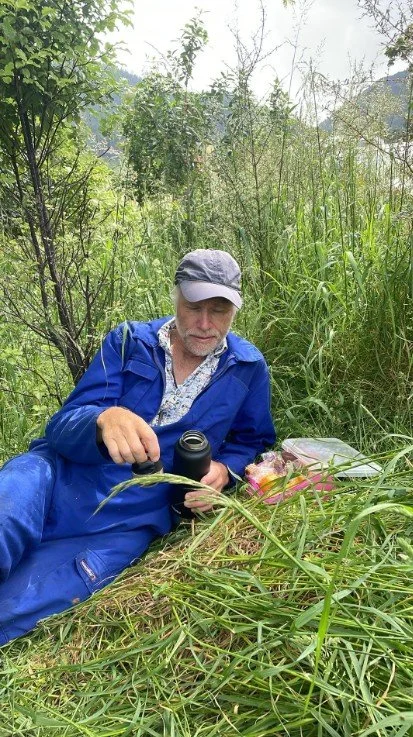
Another year has flown by, and we are definitely in the thick of trying to get on top of weeds and maintenance before the Christmas break. Definitely not enough hours in the day at the moment😊
We wish to take a minute to thank everyone for their continued support of FuturEcology and EmGuards. It has been a busy and rewarding year with lots of good growth happening in our many plantings, as well as supporting many fine planting projects around the country with our EmGuards.
It has been very satisfying to revisit some of our plantings during the last couple of weeks and see the growth on some of the sites. I was in a planting this week that was totally inundated and flattened in the 2022 Nelson floods. The plants are all much higher than me now and flourishing. We were very grateful to be able to sit in their shade for our lunch hour. So, our message to you is don’t ever despair when floods and other disasters strike your plantings. Get in there, clear what you can around those that are still standing, do a bit of infill if necessary, keep the old mans beard at bay and in 3-4 years your efforts will be well rewarded.
After a fairly tumultuous year, with lots of change at FuturEcology, we are taking a well needed break over Christmas.
We will be closing our doors at 4pm on Friday the 19th December and will be back on the tools at 8am on Monday the 12th January. Our last delivery of EmGuards to the freighters will be on Friday 19th December.
If you wish to give EmGuards as a sustainable Christmas gift idea, then it would pay to get your orders in no later than Tuesday the 16th next week. The freighters all get a bit frantic at this time of year.
Our new shed build is underway, so we should be fully up and running from there by the end of January. Very exciting. The EmGuard van will be very happy to have a new home and I can’t wait to have a good spot for dispatching our amazing EmGuards from.
In the meantime, we wish you all a very relaxing and happy Christmas. We hope you have time to catch up with friends and family, eat lots of good food and enjoy some of the nice warm weather we have been having lately.
War on Weeds
By Jan Fryer
My particular war at the moment is on old mans beard. I swear it grows about a foot a day in this warm weather.
We are hosting the local Gotta Bitta Land group here for lunch and a wander round the garden on Sunday. I was just down with the shed man sorting out the shed site, when I looked up and saw long tendrils of OMB in all the trees that border the driveway. Not a good look for a conservation company, when we are hosting landowners that sometimes seek our advice on how to manage their bitta land!
The frustrating thing with OMB is that it seeds everywhere and will root down wherever its stems touch the ground. What I particularly noticed today, was that we are getting a nice thick leaf litter under the trees, which suppresses grass. However, OMB sees this as a prime place to send out runners and root down in multiple places.
If you are faced with this, do an umbrella cut right around your tree to ensure nothing is going up towards the canopy. Then try and track the stems to the crown, cut off all the runners and paste the stump with a glyphosate-based gel. I have also been spraying any plants that are lying along the ground with a 1.5% glyphosate spray. One of the key controls is to try and prevent it from flowering.
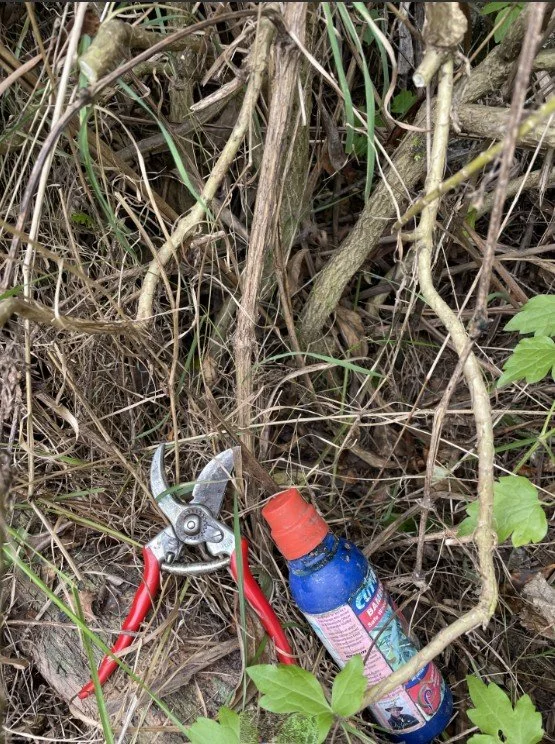
Tangled beard
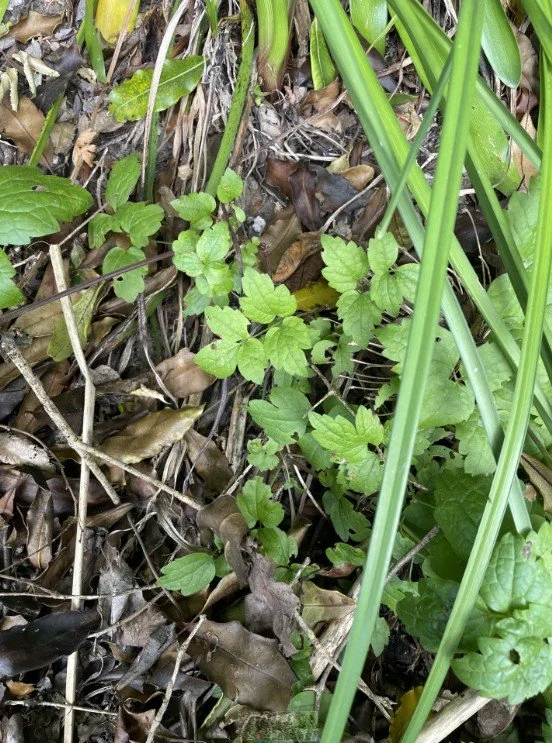
Beard spreading across the ground
Plant of the Month
Dacrydium cupressinum, Rimu
By Robert Fryer
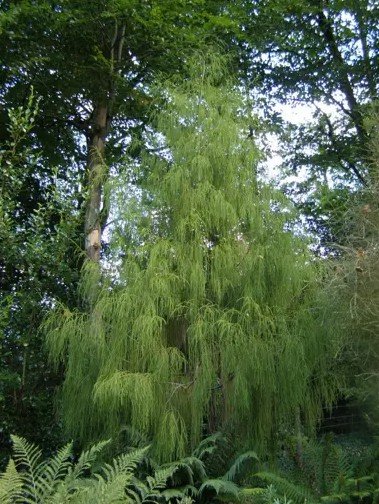
Image: The Plant Company
For a tree that is arguably the most well known New Zealand timber tree, rimu is often overlooked in restoration projects. Possibly because suitable habitat takes a while to create, especially if one is transitioning from pasture.
Rimu has been a very useful tree for New Zealand. I think about the house I grew up in, mostly built out of rimu. The timber has always been prized for joinery or decorative uses, ensuring that most of us recognise the timber, although I suspect that many would not recognise the tree.
Rimu’s conservation status is of lesser concern, as it is wide spread and very common throughout New Zealand. But what about in your local area? In our home catchment, the Wakapuaka, it has almost completely gone. Over the time we have lived here, we have seen the decline and death of the remaining few individuals in the lower Wakapuaka. In neighbouring catchments that have escaped fire and logging, they are relatively common.
Rimu is an extremely valuable tree in the forest, providing not only habitat for other organisms, but a rich food source for a number of our iconic bird species. It is one of the few species that appear to tolerate deer, as they are relatively unpalatable. However, they are susceptible to antler rubbing, often badly damaging the young seedlings.
Part of my focus over the next few years will be getting rimu trees back into the catchment, into sites that allow for successful establishment. This is taking a long-term view, especially as I look at trees I snuck into the existing riparian margin 30 plus years ago, and how they are only now emerging their way through the low canopy.
I would encourage everybody to have a think about their projects. If you have suitable existing cover and deepish damp soils that would be suitable for rimu, putting in even a few trees will make a difference over time.
Weed of the Month
Arctium minus, Common Burdock
By Jan Fryer
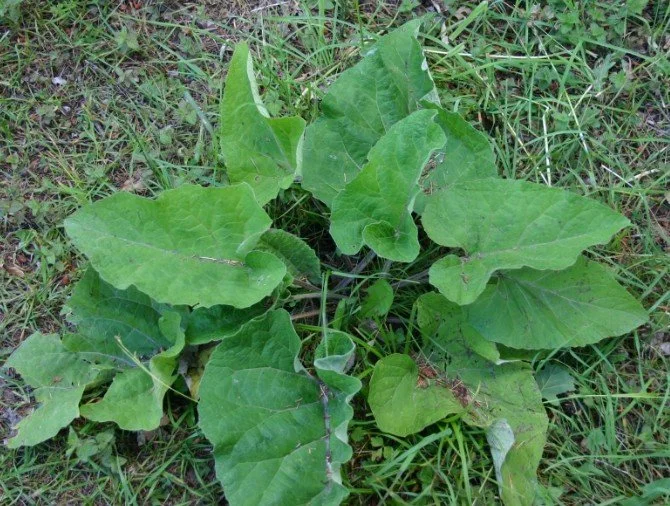
Image: Agpest
At a couple of our planting sites, we came across some healthy stands of burdock this week. This is a tall growing biennial herb, with a long taproot, native to Asia and Europe. It is a widespread weed in New Zealand.
It is used in traditional herbal medicine, as a fresh vegetable and as stock food. The root is also eaten as a vegetable in parts of Asia.
Our theory is that because it can be used as a food, seeds may have washed down in floods, and that is why we are finding it in some of our streamside planting sites.
It grows up to 1.5m high, with many branches and large hairy triangular leaves. The flower is a spiky, pink thistle-like flower about 3 cm long. These are found in clusters at the end of branches. The flower head is produced in its second year. The seeds produced are a clingy burr, so they will stick to clothing, fur or sheep wool.
Control is best done in spring on young seedlings. Manual control can be effective, provided you pull out the full taproot.
Glyphosate will deal with young plants that are in active growth, but you will likely have to do the control over 2-3 seasons as seed remains viable for at least that long.
Be careful if you are spraying it in a public area, as it is used as a food.
EmGuard Update
By Jan Fryer
EmGuards make a great Christmas present, if you are wondering what to send someone who loves their garden. They are useful for many more things than native plantings.
We have them around our citrus trees, the rhubarb, new box hedging and many other trees.
I have been reminded of their huge benefit this week, as we have been doing a major push on maintenance through one of our big plantings. Grass is waist high, but every plant is marked by a guard and stake. We have been stomping and cutting back the grass, then spraying round the plants. EmGuards are good protection against weedeater blight too, believe me!
I have plenty of EmGuards on hand for small orders, but for orders over 1500, they will be filled in late January.
If you have plantings planned for next year and intend to use EmGuards, please let us know your indicative numbers, so we can effectively plan our production and give you the best price.
Thank you again for choosing our wonderful EmGuards.
Jan’s details are:
Ph: 027 497 5838
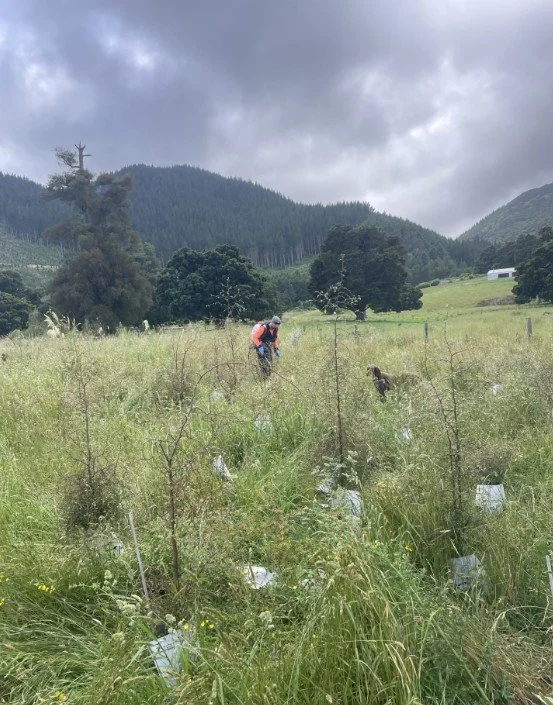
Spraying following hand clearing
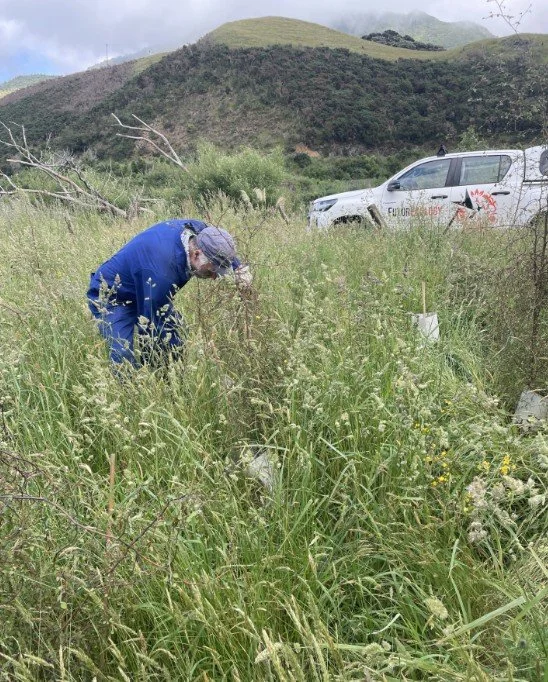
Hand clearing round two year old plantings
Interesting Snippets

What we’ve been reading
We recently gave Dan the book “Around the World in 80 Trees” and he is really enjoying dipping into it.
It is written by Jonathon Drori and wonderfully illustrated by Lucille Clerc. It is about 80 different tree species and journeys through time and across cultures, looking at the intricate relationships with people, animals and other plants. He uses up-to-date plant science, history and quirky details to demonstrate how trees play a role in every part of human life.
It came from a wonderful bookshop – Books and Co in Otaki, so if you find yourself in that part of the world over the festive season, we definitely recommend dropping into the bookshop.
A perfect holiday read.
Conclusion:
By Jan Fryer

Jan and Emma celebrating Neale Park’s first birthday Park Run.
These are interesting times we live in at present. If you are travelling to the US, apparently you need to show five years’ worth of your social media activity for them to assess your suitability to visit.
Closer to home, there are big reforms in the RMA, which is set to be replaced with the Planning Bill and the Natural Environment Bill.
There is no question that we need a simpler, fairer system. We met a client last week who was saying they had to apply for a consent to plant Carex secta along their stream edge. That stream is basically a man-made ditch that runs through a paddock, with no shading and just long rank grass. The work they proposed to do, of their own initiative, would definitely have enhanced the stream and provided much better habitat for freshwater invertebrates. However, having to go through the costly process of a consent was totally off-putting to them. Why would they want to do any environmental improvements?
I certainly hope that the proposed reforms do have a positive impact on environmental outcomes, but it will be an interesting space to watch over the coming months. While we are not holding our breath, we do hope to see a little more common sense when it comes to encouraging people to make positive environmental impacts on their land.
In the meantime, we hope you get some time to relax, check out our amazing beaches and bush, and enjoy family, friends and food.
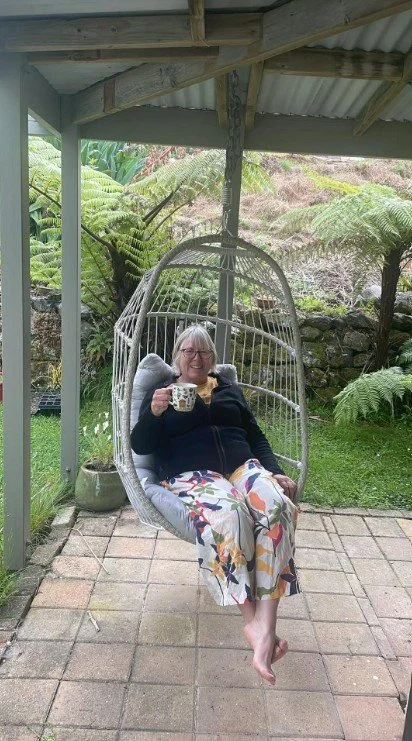

Happy Christmas and wishing you all the best for the new year.
See you in 2026.
If you have any projects in mind and would like to talk further, give us a call or pop in and see us.
We look forward to hearing from you!